A couple years ago I started using the log flume story when teaching small moments in fifth grade. We asked the kids, “What’s the smallest moment that makes a story?” And then we helped them zoom in to a moment, choose a small piece of it and make it into a flip book.
My big story takes place on an evening at an amusement park.
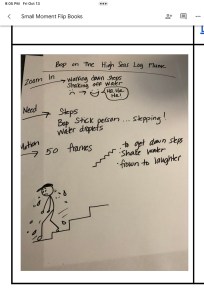
My small moment is the time my son wanted to ride the log flume.
There are flashbacks too. There’s a short mention of the time I loved to ride the log flume as a child, and a small narrative about forcing my kids to ride the log flume at Hershey Park, not remembering how very scary it could be at the top if the ride. The way the boat tips forward and back, the way you feel like you are certainly going to fall off the side, the way the boat feels like it is about to tip all the way forward. Traumatic.
The story itself is pretty simple. With only a few tickets left at the amusement park, and my memory of how scary the top of the log flume is, I turn to my dad. The kids call him Bop. Bop doesn’t like water. He almost never swims in the pool in the summer, and when I was a kid, you just knew not to involve him in any water play.
Bop wants to make sure there he won’t get too wet.
I don’t remember. I don’t think you get too wet.
He and my son get on the ride, and the rest of us watch them go up.
It’s not until the boat starts tipping back and forth on the top, that I start remembering that actually you do get pretty wet.
We watch the boat go down. We watch the giant wave splash over the boat. We watch my son and my dad step out of the boat, soaking wet, walking down the steps. There’s a look, a frown, and then thankfully, there’s laughter.
This is the moment I zoom in on.
The students help me plan my flip book sequence, and then they begin planning their own.
This year I also used the log flume example when I was teaching about the heart of the story.
“What’s important in here that I want my reader to hold on to?” I asked a class, thinking aloud. “Maybe it’s this idea that my dad did the log flume for my son, even though it wasn’t his favorite thing. Maybe it’s that sometimes in life, you do things for others?”
I wasn’t sold on the heart of my story though. I wondered if maybe I needed to think of another story to use.
And then my cat, Theodore, died on a Sunday night.
It was an awful night. I didn’t know how I was going to go back to the vet to pick up Theodore’s body by myself. Of course my mom offered to drive over to help me.
“I’m on my way,” she said over FaceTime and less than a half an hour later she was at my door.
Next to her was my dad, shovel in hand. He thought he may as well help.
I showed my dad where to dig the grave on the edge of the wooded area of my yard. I held the flashlight, he dug through the rocky, sandy, root filled dirt.
“Well,” I told him, “I didn’t think I’d ever be digging a grave by flashlight with you. I hope we don’t have to do this again.”
But while I watched him dig, I started to understand the heart of my story.
My mom and I drove to pick up Theodore, and when we got back, my parents watched me and the boys cry and give Theodore one last scritch.
My mom swaddled Theo’s body, and my dad helped her lower him into the grave.
After they left, the boys and I cried some more. I told them that I hoped when they remembered this terrible day, they would also remember that Granny and Bop dropped everything and came over. It’s a big deal, I pointed out, and the boys agreed.
Thats what it means to show up for people.
The next day in fifth grade writing, we were talking more about the heart of the story. I couldn’t talk about Theodore yet without crying, but I wanted to tell the class that I figured out the heart of my story:
Sometimes in life we are lucky enough to have people show up for us.
 On a Thought
This is beautiful and heartfelt. A lovely read, Ona!
This made me tear up. What a beautiful heart to your story and slice… and how lucky you are to have such amazing parents/grandparents to your kids. ❤