

You can read the first part of this: 5 Minutes Until Writing Class here, from yesterday’s post.
The third-grade teacher starts writing by reminding the students of the work we have been doing with Literary Essay, and telling them how exciting it is that they are ready to lift the level of their work, trying it out with some of their favorite books. I’m ready to help her co-create the anchor chart with them while we do a class example using Because of Winn Dixie – she’s taking the lead in our co-teaching adventure.
“What are some things you remember about Because of Winn Dixie, or the character Opal?” She asks the kids, and they turn to talk together. As the chapter of turn and talk begins, we hear one voice rise above the others. This third-grader who used to stop me in the hall when she was in first grade just to tell me a joke, says clearly without a trace of sarcasm, “There. Was. A. Dog.”

. . .
Students are working on their graphic organizers, thinking about their favorite book and making claims about the character’s trait or change, or lesson learned in the book. This is hard work! I walk around leaning in, checking in, coaching in.
One student has written “wis(end.)”
“Oh!” I smile, “Are they wisened? Did they change to be wise at the end of the book?” I ask, thinking that maybe that word, wisened, could go in the character change part of the graphic organizer too.
“Yea,” he says. “In the beginning, he is just a clumsy mouse with sandals.”
…
At the next desk set, a third-grader is doing her work with the book Blended. I have seen this book before, but haven’t read it, and I think it has some complex themes.
She is working really hard, and thinks that maybe this character doesn’t change.
I know that books at this level almost always have some sort of character change, so I’m going to have to push her thinking a bit. I quickly scan the back cover, and flip through pages while I ask her a few questions.
“She is an optimist,” she tells me. “She’s an optimist and she stays an optimist. She still has to go back and forth to her parents’ houses at the end and she still doesn’t like that.”
“It sounds like she has a lot of hard things in her life.” I point to what I’m reading on the back of the book. “Sometimes in books like this, the change is really an inside change. Does her perspective change maybe?”
Suddenly she is writing, and I ask her a few more questions. I’m just so excited about the conversation!
I say something like “Does she learn anything along the way? Sometimes that can help us notice the way a character changed.”
She looks at me and tells me, “I’m writing the lesson now, and then I’ll write the change.”
She’s so polite, and it’s a good reminder that I need to close my mouth.
I tell her, “I’m so sorry. It’s okay to say, ‘Ms. Gabriel, stop asking me questions and distracting me!’”
She gives me a small smile and finishes her character’s lesson. I think she is going to say something like, “She learned that sometimes in life things are hard but you can do hard things.”
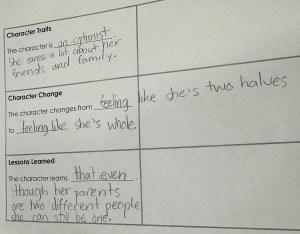
But nope. She writes, “The character learns that even though her parents are two different people, she can still be one.”
I ask to take a picture, because this is amazing, and then she works on her character change claim which she gets to more quickly, “The character changes from feeling like she’s two halves to feeling like she’s whole.”
This is one of many times during the day that I am reminded that kids can do so much. They are such capable, smart, amazing thinkers.
…
I turn to my next conference. She is working on trying to figure out Piggie in Elephant and Piggie: I’m a Frog.
This one is challenging in a different way, and we are discussing if Piggie really changes in this book.
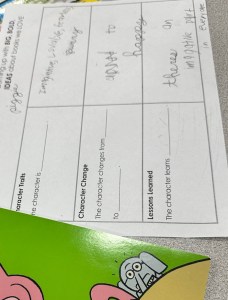
She thinks maybe Piggie changes from upset to happy. She isn’t wrong, but I think it would be a stretch to write a literary essay about that character change.
I wonder what lesson she thinks Piggie learns in this books — since Piggie is the one who works to teach Elephant something about imagination. But, she says that Piggie learns that there is a negative part in everyone.
Again, she isn’t wrong. But, for the work of the essay, we talk about focusing on Elephant instead, who goes through a more evidenced change, learns a more specific lesson. She ends up taking notes on both characters.
…
The students are about to start cleaning up, and the teacher and I have a quick reflection.
This work is hard. Have they done enough choice reading this year to do this work? We had encouraged them to find one of each kind of claim: a trait, a change, and a lesson. But, we had also given them an open book choice. We remember that not all books have a character change.
We think, maybe that’s okay. All the kids can find a character trait to write about, and some of them can find a lesson learned, and a few of them can find a character change.
…
The students clean up their writing supplies, I say goodbye to the class, and walk out looking forward to our next time together.
 On a Thought
Wow! I’m impressed with this work! Way to go third graders! ❤
I just loved sneaking into your day with you. Thank you for this reminder: “This is one of many times during the day that I am reminded that kids can do so much. They are such capable, smart, amazing thinkers.” It’s so true, and you collected a ton of evidence today. AND YES YES to book choice. Oh, how kids need to find characters THEY love, not just characters we love 🙂