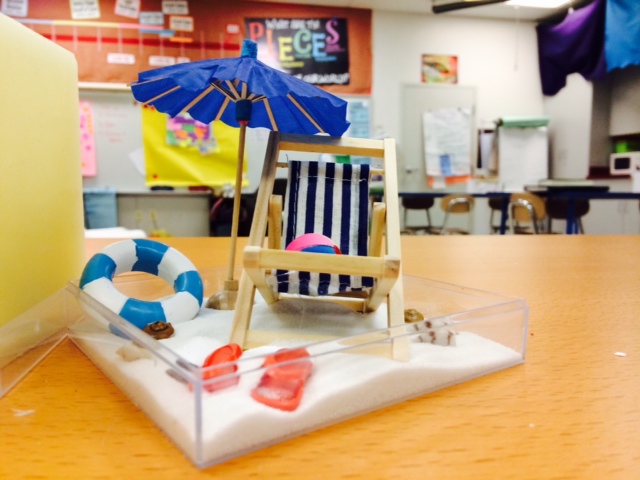
It's a NEW YEAR Still the same School year But a NEW YEAR! Last time I blogged it was 2014 If I don't hit "new post" and then "publish" now, another month might go by! I blog in my head sometimes, when I think I'll open my laptop after the kids go to bed. I have Celebrations of running (5 whole miles! Me!) Slices of fun and mess on Christmas Day My baby turning 5 I want to share Reflections from my Winter Book-A-Day A lesson comparing Letting Swift River Go to a piece on Global Warming Refugees and how just today I procrastinated grading late work by cleaning off my desk to make room for my new beach.I know I need to choose ONE WORD and my #nerdlution promises But, for now I just decided to break the cold 2015 ice I just decided to write.
Category Archives: Reflections on teaching
A slice of Roses

Part of Slice of Life by Two Writing Teachers. Head over there for information and links to more Slicing!
It’s winter cold season around here. My son came home on Friday with a low fever and has been coughing ever since. I started getting the cold on Sunday night, my daughter started getting a sore throat Monday morning, and my youngest started the sniffles last night. I’m a baby about being sick. So, last night I went to bed early, woke up an hour later, tried to steam away my cold in a bath… which ended when my 8 year old woke up coughing. I spent the whole night taking small naps in between waking up to him coughing, giving him water, cough drops, etc. This caused me to stay in bed too long this morning, leave my house at the last possible second, and arrive in my classroom just a step ahead of students.
As I unpacked my laptop, and organized my morning things, students were crowding around me, sitting next to me, talking about how tired they were, how they didn’t feel good, how they had been wishing for a 2-hour delay… (Me too, guys. Me too.) The general feeling of blah was all around the room.
I wished for just a moment that I had some nice (quiet) independent work they could do. A word search! A journal entry! Read to self! But, I knew we needed to gather in our morning circle, so gather we did.
“Wow,” I said. “It seems like maybe I’m not the only one feeling discombobulated this morning… Other people are telling me they are tired and sick, and wishing they were back in bed…”
Students nodded and agreed. So we did our “rose and thorn” activity. Going around the circle, students shared a thing they were not happy about today (thorn) and something they were happy about (rose). As we went around the circle, it became clear that I was right: everyone was tired, or had colds. As one student remarked, “Everyone’s sick! This December sickness is killing us!”
But, listening to the roses was just what I needed. Basketball games, grandparent’s visiting, holidays coming, and my favorite, “But my rose is, I’m alive!”
We ended our circle with a 1-2-3 “clap,” and we were off to math. Some days are better than others, and I can’t wait until all the sniffles and coughs are gone. . . but I plan to try to keep remembering the roses.
Slice of bus duty
Part of Slice of Life by Two Writing Teachers. Head over there for information and links to more Slicing!
I’m on bus duty and I’m freezing at the parent pick up area. It’s almost the end of my bus duty weeks, and I’ve been watching.
I watch as kids walk down the path. I see kids in groups, loud and laughing. I see kids arm in arm with friends, and kids walking alone. I see kids smiling, kids weighted down by backpacks or bags of library books. I see kids looking concerned and kids just concentrating on leaving.
A few of my current 6th graders wave a quick goodbye to me, as they scan for their parents.
I catch the eyes of 7th and 8th graders who used to belong to my classroom, and call them by name as we say goodbye. It feels good to know these kids.
My teacher ears pick up snapshots of conversations that are happening in small groups that assemble around me.
“You should date her.”
“Remember that time…”
“Did you text him?”
“Is your mom coming to pick us up? It’s cold.”
“You’re a loser.”
One group gets loud and obnoxious in an unsettling way: a playful push here, a throwing of leaves, an inappropriate remark that almost crosses the line, but did I really hear it correctly?
I move myself closer, and wonder about the rules.
In school, you can’t call someone a loser. It’s not okay to make inappropriate jokes that make others feel uncomfortable. “Your mama” phrases aren’t tolerated. In my classroom and with the students I interact with, I try to make these learning experiences. I don’t want to bully you into not bullying – I want to help you move towards kindness. On bus duty it feels different. I don’t know these kids – not even their names. I don’t know what norms they have settled on in their 8th grade hallway. I know that it has always seemed looser, as if the 8th grade teachers know to let the 8th graders spread their wings. But unkindness is hard for me to hear without intervention.
In school, you can’t have your cell phone. As soon as the bell rings, students walk out the door, cell phones out. By the time they get down to parent pick up, they have already texted and instagramed, tweeted and occasionally even called, to their hearts content. Groups of middle school students stand with phones out, having conversations with the people next to them and the world at the same time. I am unsettled by this, but is it against the rules? Don’t I tweet and text and read on my phone when I’m bored? Don’t I think think that kids deserve to feel connected? I know so many benefits of connection and technology, but I feel like I’m watching the introduction to a real life Wall-e, where students are connecting only through this device, and not with the people right next to them.
I’m on bus duty, and I’m watching. I am trying to make sure you are safe but I think I may have failed. I see you walking alone, and I see you navigating your friendship groups. I see you telling loud obnoxious jokes, and I see you look at me wondering what right I have to intercede. I should have introduced myself to you and your friends and found some common ground. Instead I reverted to my early teaching days – when I had 8th grade lunch duty and 8th grade study hall. When I didn’t know what I was supposed to do so I just became an enforcer.
“That’s not okay.” I say as you throw leaves at the girl next to you.
“She doesn’t mind.” you tell me with the air of defiance playing on your face.
“Well I do. So, stop.” I say. I can tell my eyebrows raise into my teacher face.
And that’s all I’ve got on bus duty: an eyebrow raise and an enforcing “Stop.” I’m on bus duty and I’m freezing at the parent pick up area. It’s almost the end of my bus duty weeks, and I’ve been watching.
Reflection on Visual Notes
I shouldn’t admit this way I sometimes plan, especially after the brilliant day of curriculum writing I just had with Jessica Hockett and Catherine Brighton, and the K-6 ELA curriculum committee.
True confession: Sometimes ideas just sit in my brain for a bit, stewing. I see something a student did, and then I see an idea pinned on pinterest, and then those ideas mix around with things I think are fun, or authentic, or better yet both. So I google, and take notes, and think. And then suddenly in the middle of the day, the idea pops out. It’s done, and ready for the kids to try. That’s what happened with Visual Notes. I saw pins like this, this and this. I watched this. I thought about the work we have been doing with wonderopolis, with noticing our thinking before, during and after reading, and I decided it was time to give it a try. So I ran with it.
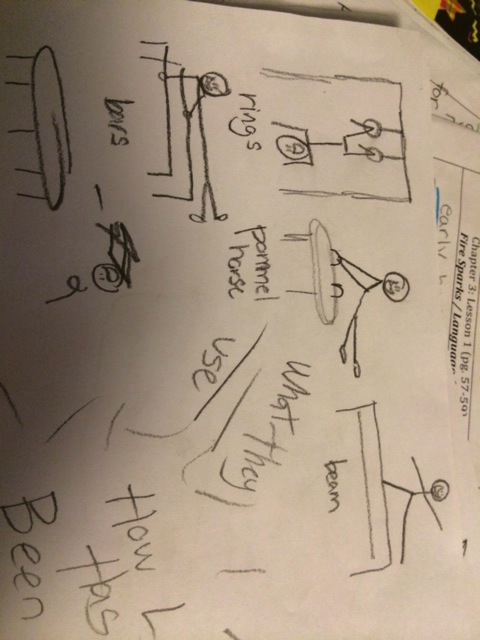
I explained Visual Note Taking by taking visual notes about visual note taking. (Wish I had a picture of this – but it talked about visual notes being like mind maps, a way to organize information, and not about our drawing skills.) We jumped in with Wonder #1332: How Long has Gymnastics been a sport. I did the activity with the kids, and loved how I could use my whole page, and my fun pens. I showed my example after we were done working and was happy about my information. I shared with my class that I wished I had been able to use some of the cool drawing ideas I had seen on pins like this and this. I also hadn’t left enough room for my own questions, and it just wasn’t as awesome as I wanted it to be.

I was impressed by my students’ work. Some were words only, organized in bubbles like a web – but still great notes. Others added pictures to organize things like the different tools gymnasts use. All of this led to a great conversation about how these notes were our own thinking put together with the author’s Wonder. I could tell that students were getting ideas from the notes we looked at together.



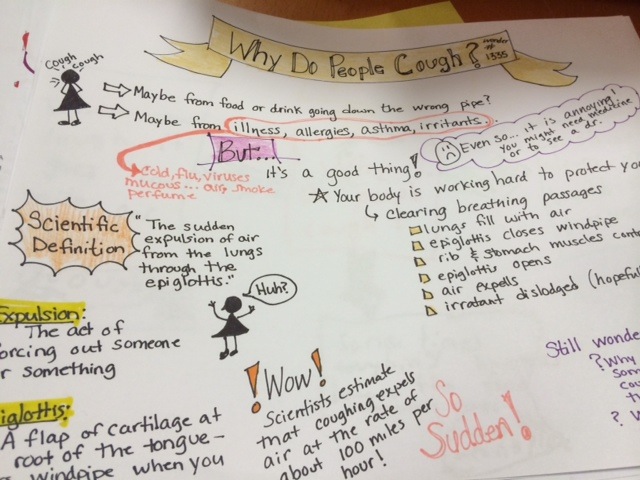
My other reading class assessed my visual notes before beginning their own. I did their wonder with them as well: Wonder #1335: Why Do People Cough? This time, my second time through, I was able to use some of the techniques I had been wanting to try out. My second try is nowhere near perfect. But, it is an improvement. I added color, and a few of my own thoughts. I even used stick figures to emphasize.
Later that day in Social Studies, this happened:
Me: Okay, I have a crazy idea, so stick with me. . . Let’s take collaborative visual notes on the Neolithic Age!
yada yada yada, directions, discussion, etc….
Student: Wow, Ms. Thought! You said this was going to be crazy, but you never said it was going to be crazy cool!
Even later that day, while grading papers from a few days prior, I found this as notes on a student’s paper: 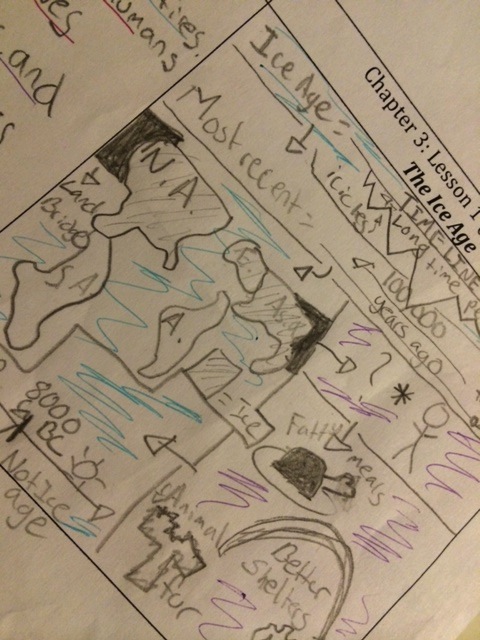
Kinda like they already knew how to do this visual notes thing!
Since I started this mini unit on Visual Notes in my classroom, I have continued to read about the concept. It feels right, yes, but I also know that it is helping students sort out all the information they are reading, and combine it in order to design their own understanding – in a fun and creative way. I love that they are practicing this tool!
Today in my curriculum development session, I decided to practice my own visual note taking with a live speaker. Whoosh! It was engaging, helpful, and fun.
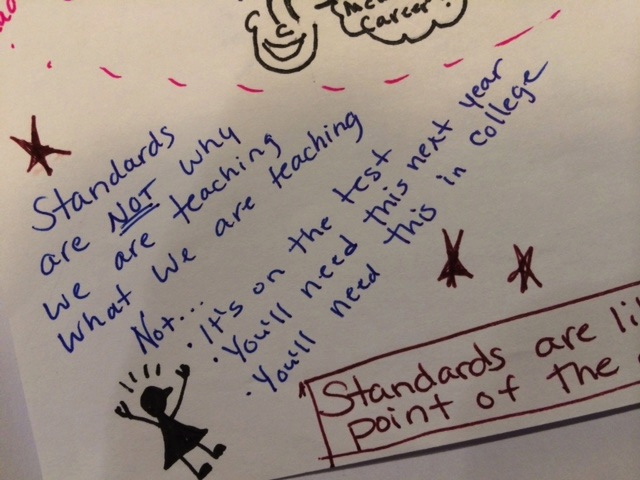


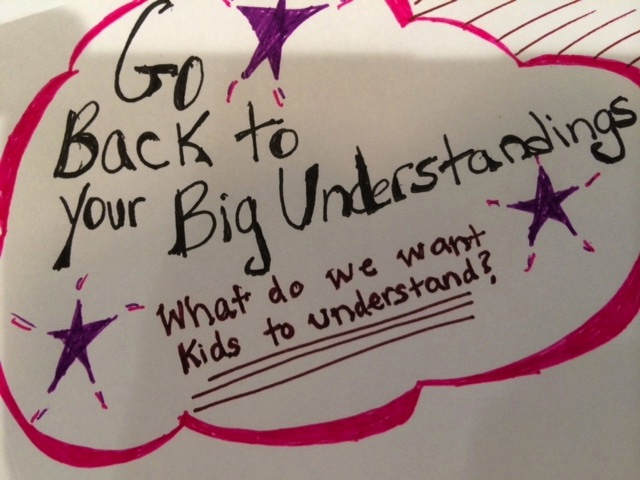
I’ve always enjoyed doodling, but honestly couldn’t tell you if it helps or hinders my listening skills. But today, with the visual note taking? It helped my understanding and my ability to synthesize the take away points. I can’t wait to try it again in my teaching and my learning.
A slice of my morning drive
Part of Slice of Life by Two Writing Teachers. Head over there for information and links to more Slicing!
My drive to work is the same, more or less, every day. How rushed my morning is, and what time I leave dictates which way I start my trip, but the last leg is always the same.
On rushed, bad days, I race out of the house. Guilt trails me down my front steps after I hurriedly give my kids their kisses and hugs, and I speedily remind my husband of a few last minute things. Guilt follows me into my car and reminds me of the stretching out of that connection to my family as I drive farther away. I distract myself with the radio and then halfway to school my mind starts filling with my school to do list.
On good days I have a little more time with my kids, and I give a few more hugs and kisses. Some days, my kids walk me outside and run on the sidewalk as I drive away. Guilt is still my company on good days, but I’m more comfortable shutting her up.
Best case scenario, I’d use each of my 20 minutes up like I’m licking the last bite of the chocolate syrup out of my bowl. Occasionally I do use most of my trip for mindful thinking. I think of a lot of things I’d like to write about during this time, but driving isn’t the best time for writing. . . (I tried to dictate something once… but my phone got really confused, poor thing… and it would need to be a post called “A Slice of Autocorrect” I guess!)
Sometimes as I turn in to my school’s neighborhood, I see a father and children waiting for their bus. Last week I turned the corner as the bus was closing its door. The father waited as the bus did its bus things – a small jolt backwards and then a slow start. He stood and he waved and he blew a kiss. I stared and I cried and I thought. I thought about how I try to make my classroom a home away from home but how it isn’t a home, it’s a school. I thought about how I care for my students and protect them, but how I’m not their parent. (Their parents waved goodbye to them this morning, I hope.) I thought about parents waving goodbye to their kids starting in preschool. I thought about that connection we have to our children, and how it stretches and stretches as we send them off to school and sports and playdates (and one day real dates! and college! and marriage!)
Now I notice school bus goodbyes everywhere on my morning drive. Parents wait in cars with their kids at the bottom of long country driveways, and parents walk back after busses have pulled away.
If only I could leave school in time to see busses pulling up again, and kids hugging their parents hello! I think that might be good for my soul.
Celebrating Play

I’m participating in Ruth Ayres Celebrate This Week. Check out the link up here.
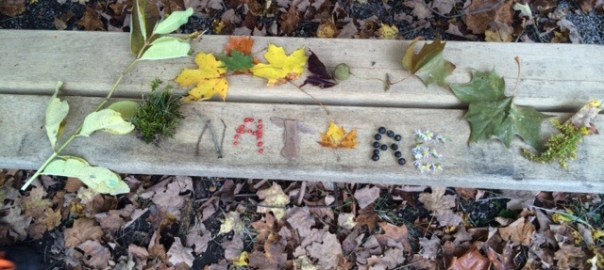
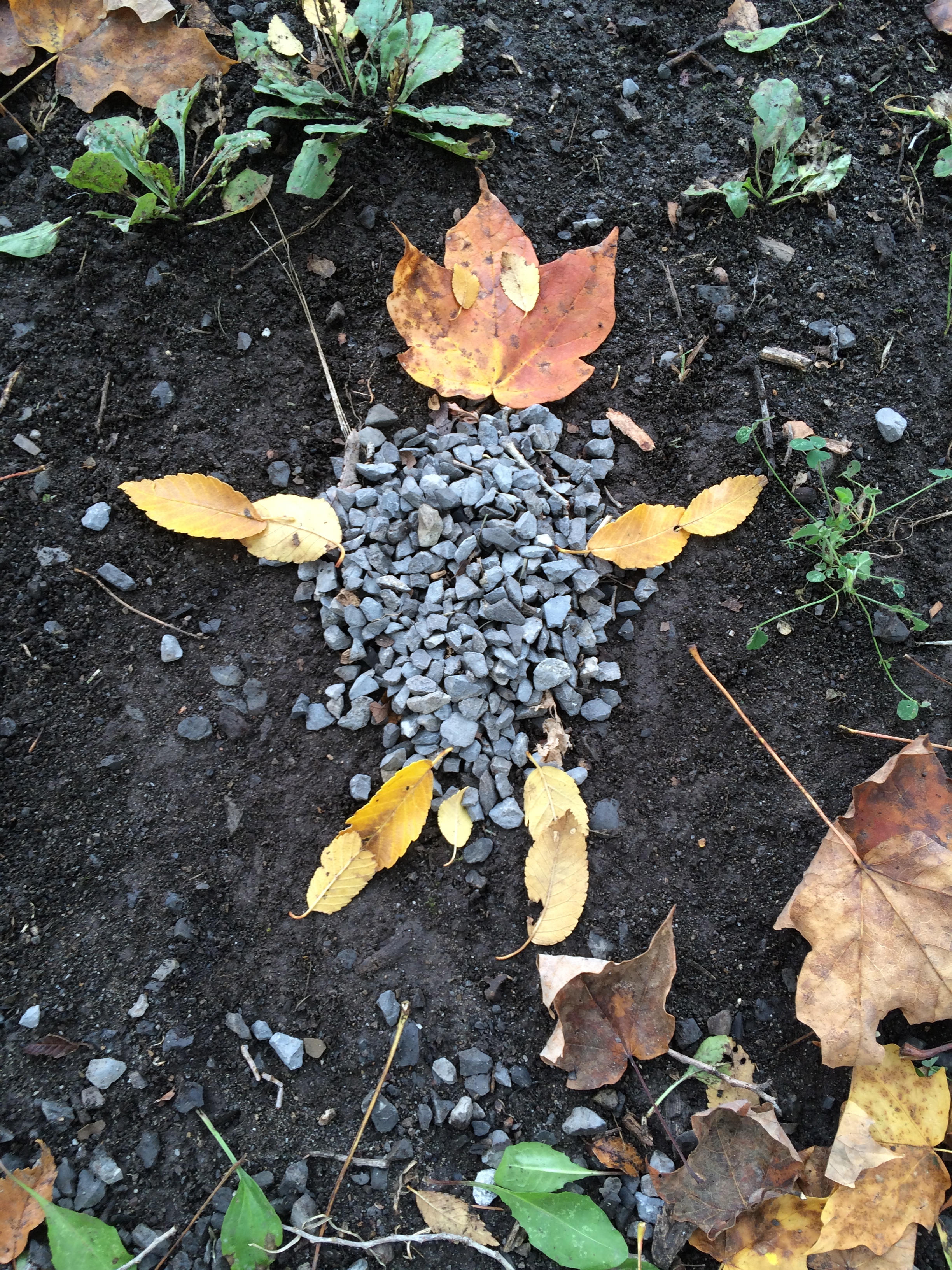
On our field trip this week, I sent my students off with vague directions to make nature art a la Andy Goldsworthy. I told them the boundary of where they could look for supplies, and where they could create their art. We brainstormed a few examples before sending them on their way: Fairy houses, designs, pictures…
I expected them to grab a few leaves, maybe some rocks and twigs. I expected them to have a little fun, maybe. I knew this was a new kind of creative activity and I just wanted them to explore the idea.
I didn’t expect them to play with the idea. I didn’t expect them drag huge fallen tree branches into the clearing. Watching them figure out the physics of balancing these branches was something to celebrate. Watching them rise above my tiny field trip expectations was something to celebrate.


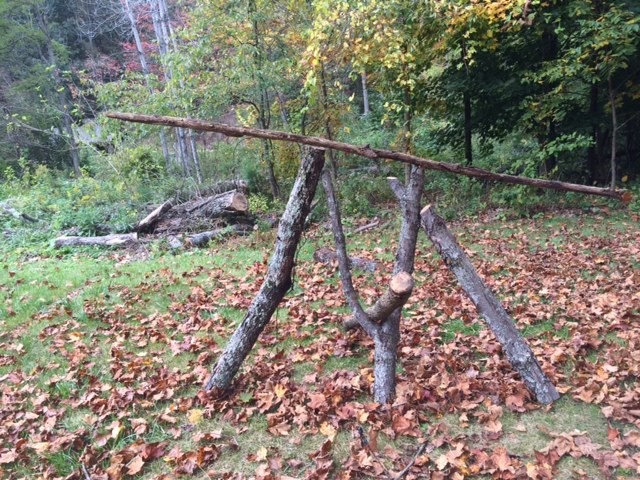
I didn’t plan ahead of time for the amount of collaboration, introspection, and problem solving that was involved with this project. I didn’t even write objectives for this field trip activity. (Shhhh…) I did the station on the field trip because it sounded fun, and like a respite from the hike, the team building, the canoeing and the scavenger hunt
Today I’m reflecting on the activity and celebrating the play. I don’t forget that my 6th graders are kids, but sometimes we get too busy to play, and sometimes I let people and situations convince me that these kids don’t want to play. But, it’s not true. Not only do they want to play, they need to. If the play was just a break, they would still need it. If the play was just for fun, they would still need it. But it isn’t. Play is their work, their research, their practice.



“Play is the work of the child.”
– Maria Montessori
“Play is the highest form of research.”
– Albert Einstein
“Play gives children a chance to practice what they are learning.”
– Mr. Rogers
A slice of mindfulness
Part of Slice of Life by Two Writing Teachers. Head over there for information and links to more Slicing!
“Wait! We didn’t do mindfulness today.” A student reminds me as we are about to get started on some social studies reading.
I was at a training this morning, so my classes missed doing mindfulness. I am so happy that they missed it, that they wanted to do it. They are noticing the peace, I think. “Do you want to do it now or after the activity?” I ask
“Now!” the majority answer.
Like usual, we settle in. I ask the students to get comfortable, “Criss cross applesauce works for most people” I find myself saying (almost every day). “Your eyes are closed, my eyes are open. Settle yourselves. Be still. Begin to notice your breathing.” I look around and I see them settle. There are a few in each of my classes who still struggle with the settling part. Their legs can’t seem to stop moving for very long, or they are forcing their eyes to be shut because they really really really want to open them.
They have gotten so much better though, in the past couple of weeks. In the beginning, I had to remind myself that this wasn’t last year’s class that already knew how to do it. But the results are stunning, anecdotally, of course.
In my hour + math period, we do a minute or two of yoga and then a minute or two of mindfulness, and some days we try to take a brain break by running off some steam outside. Last week I reflected on the difference between the day that we missed the mindfulness and the day that we missed the break. The day that we missed the mindfulness was not a good day: My students struggled with keeping focused. It was then that I realized that maybe this mindfulness was better than I had thought. It’s hard to give even 2 minutes to something that isn’t directly related to academics, but these few minutes a day seem to be working.
I look around at the quiet faces of my class, and feel lucky for this moment of quiet. I know the research says that this quiet mindfulness is good for their academics, their self-regulation, their focus, and for decreasing stress and anxiety. But at this moment, I just feel grateful for the peaceful calmness we are fostering in our classroom. It feels like a gift.
Later, settling in at home, I will come across a great article on edutopia where Meena Srinivasan is talking about her book called Teach, Breathe, Learn: Mindfulness In and Out of the Classroom. I will read her reasons for practicing mindfulness in the classroom, and I will feel so relieved that I’m not crazy for just being grateful for the peace. I can’t wait to read her book. She says,
“Mindfulness is empowering because it helps us see that in every moment we have a choice; we can choose to be more skillful, and there are concrete strategies that can help us bring more peace, love, and joy into our lives.”
A (few) Slice(s) of Homework
Part of Slice of Life by Two Writing Teachers. Head over there for information and links to more Slicing!
“I feel so…good! Mommy. I don’t know if you know this feeling…when you get something done. Not the homework kind of done, but a good deed.”
H started 2nd grade this year. I wish you could have seen him before school started. He was ready to be a second grader: So excited to go to school. He loves learning, and his curious creativity drives him daily (in and out of the classroom). He started school at the end of August, and he still loves it. His teacher is also curious and creative, and she seems to get him, which is nice. It is especially nice because the teacher he had for kindergarten and first grade is what I would call an angel of a teacher, and I’m sure she will never be topped. (My love letter to her is a different post.) So we had wondered how the transition to a new teacher would go. This year, H said, just a few days in… “I know that I have Tr. R for second grade and third grade, but I should probably have her for fourth grade too.” Okay then! 2 awesome teachers in a row, who could ask for anything more?
I guess I can. I can ask for no homework. H gets math each night, and then a selection of other homework assignments, given over the weekend and due on different dates. Make no mistake, the homework assignments are interesting and worthwhile assignments. There is a night of reading. Some weekends we have been good at getting all the assignments done so that we don’t have to worry about them during the week. I like spending time with my children, and sometimes the time we spend doing homework is enjoyable. Tonight I sat with H as he did his math. The practice was easy for him, so he spent some of his energy being creative. “Look, I can write my ‘o’clock zeroes’ with sideways 8’s!” We smiled and laughed and practiced some clock math. It was not a bad way to spend 15 minutes.

Other times have not been so peaceful. More than once H has said, “I hate school.” You know when he says that? When it’s time to do homework. It is usually a battle. “You can do that after you do you homework,” is a phrase Mr. Thought and I say a lot around here. My middle school daughter loves school too. She struggles with some math concepts, and some might say that is why she should do more homework. But I’m not so sure. She has been working at school all day. She comes home and needs some down time. She needs some time to play, practice her piano, eat dinner, talk with us, help with chores. She needs to get ready for bed… There are only so many hours in the day. Several nights last week she ended the night upset that she hadn’t had any time to read. Now part of this is her own time management skills, for sure…but I have been waiting for her to catch the reading bug, and hate to see her not reading because she’s practicing long division. More than once she has said, “I don’t need extra help with my long division, I just don’t like math. I don’t care about it.” I’m thinking 15 practice problems at the end of a long day aren’t going to make her care about math.
Full disclosure: I have a problem with homework in the elementary and middle school years. For the past month or so, I have been noticing slices of our homework life at my house. I have read The Homework Myth by Alfie Kohn. I have read numerous other articles and research summaries about homework, and I have seen friends’ postings on Facebook. I am not alone in my dislike of homework.
I know. Some students like it. Some families feel it is important. Sometimes the practice benefits the student whether they enjoy it or not. I know. I know the pressure in my own teaching: So much curriculum, so much to do. There isn’t enough time. Ever.
Two weeks ago, I gave my students a timeline assignment. They had some time in class to work, and I told them they would need to go over their timeline with their families to help with the facts, etc. I assigned a due date. The day before the due date I had a different activity planned… so much curriculum to get through, you know. But then I noticed that students needed more time, and I asked myself: If this activity wasn’t worth class time, why was I assigning it? Why would it be worth home time? I scratched my plans for that period, and gave them that extra hour to work. (It was worth the time, by the way – getting to know your students through an authentic activity is, I believe, always worth the time.)
I wonder about homework. If we give practice homework that kids aren’t independent in, then they may practice the wrong thing, or struggle through an understanding in a way that causes more frustration than it is worth. If they are already independent in a skill, do they need that practice? If we give the same homework to every student, how is that differentiation? But if we take the time to differentiate, is that amount of time worth it for homework that they will be doing without our observation and support? If research studies aren’t showing that doing homework before high school leads to better study skills and organization, is it worth the headache? If homework is practice, is it something that you should ethically be counting in a grade that is meant to show how well a student understands? (Check out Rick Wormeli’s thoughts on grading homework here.) If homework does help academics, what gives schools the right to dictate a student’s time at home?
It should be enough that research doesn’t support homework. It should be enough that the majority of parents don’t want their kids to be doing work during family time. (See this study, where at my last check, 75% of parents wanted a “no homework” policy) It should be enough that kids work all day. But for some reason, we still do it because “We’ve always done it this way.”
If you were to look into a window of my children’s time at home, you would see what might look like a mess of legos and playdoh, paper, markers, dress up, dolls. . . Sometimes we spend a day on a beautiful family hike.

To be perfectly honest, I wouldn’t want homework even if all my kids did in their free time was play. I believe in the power of play and that for kids, playing is their work. However they aren’t just playing. By 1:00 this past Sunday afternoon, H had already done the following non-homework activities: Cleaned and reorganized his bedroom, sorted legos with his 4 year old brother, researched how our cat goes downstairs by videotaping him in slow motion on my phone, and measured and figured out the timing of our ceiling fan. He slowed down for a snack and some time hanging out with Mr. Thought. L, my 10 year old, had a similarly busy and productive day, in addition to reading her current chapter book.

I watched H’s slow motion video of our cat on Sunday afternoon, and hated that I had to say, “Hey! you could write about this in your research journal homework!” He didn’t want to open his backpack, but I made him. We printed out a picture, and glued it in.
I hope I didn’t teach him that the only learning that counts is the stuff you do for other people. I hope he’s right, that a picture is fine, he doesn’t need to write for each entry.
Instead of worrying about it, I settled in with my tissues and water (go away, cold!) and listened as Mr. Thought read Harry Potter to us.
A slice of scattered; A scattered slice
Part of Slice of Life by Two Writing Teachers. Head over there for information and links to more Slicing!
I’ve gone back to google 3 or 4 times in the past few minutes, always with a mission: find the lunch duty schedule so I can organize the team’s recess duties… And each time I go back to it, I open a different document. It’s not that I am wasting time on pinterest here, I am opening my reading plan notes, my conference schedule (and okay, once I opened facebook instead – but that was worthwhile, as I found this all about using bubble gum, and my partner teacher is planning a bubble gum lesson, so I believe that’s what you call kismet…) (Oh – and okay, this last time, I opened the document but then came here to write my slice…) I just have so many things to do and my mind feels scattered.
At school I’m teaching, helping students with lockers, walking around getting people where they need to go, having meetings and occasionally stopping to pee (sidebar: It’s such a good day when there’s a stall with a clean floor, clean seat AND toilet paper, don’t you think?) My planning period is late in the day, and when my meetings are over, and I finally sit at my table, my mind is still going a mile a minute, trying to prioritize the one billion things that need to get done. I begin to work, and the students are back from Phys. Ed.
After school, I take a walk to try to clear my head (and get a wee bit of exercise… more than the constant circling of tables in my box — I mean classroom.) I change my schedule, have a conversation with my instructional coach, and pack up. Home by 5:20.
Washing lunch boxes, making dinner, eating dinner, cleaning up, making lunches, going outside to see the (amazing!) double rainbow and getting the kids showered, jammied, brushed, cuddled and read to (Harry Potter 5!) take me all the way until around 9:30… which is when I start… morning letters for tomorrow, finalizing plans, checking and responding to emails… and attempting to open that google doc, or the other one.
Then I realize it’s Tuesday, and this is my slice: My brain, the second week of school. I know this work is worth it – every extra thing I do to help my students build a strong community is worth it. Every email I write to parents, every well thought out plan for my reader’s notebooks — All worth it. But this exact moment, my eyes want to close, and my brain is too scattered. So I will take the advice I know you, dear reader, are thinking while you read this: Go to bed! Get some Sleep! Then, fully rested: make a list!
What other advice do you have? How do you keep your brain from getting scattered these first weeks of school?
A slice of the first day
Part of Slice of Life by Two Writing Teachers. Head over there for information and links to more Slicing!
First Day Eve
Bookshelves ready, plants watered

Activities planned
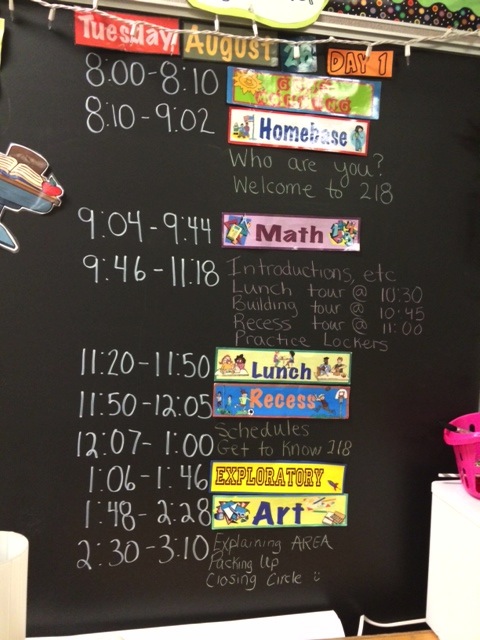
Objectives written on the board (!)
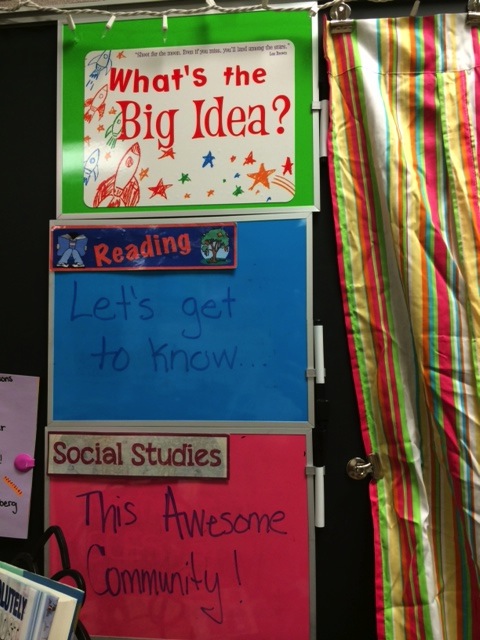
Photo booth props gathered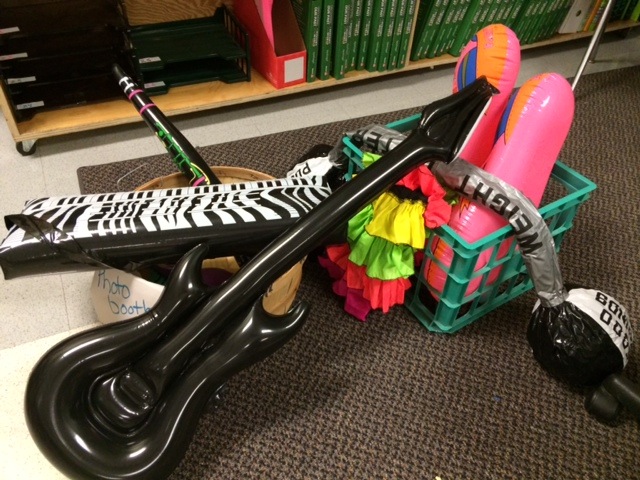
Name tags strung
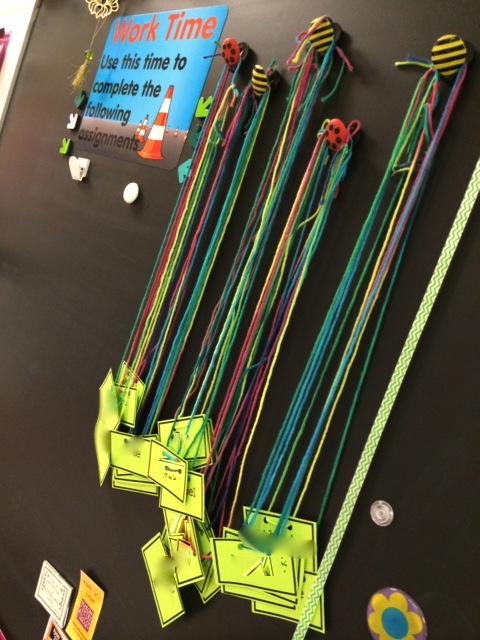
Plans reviewed, teacher tosses and turns, plans reviewed again
First Day of School
Ready or not!

What a day! A Feet hurt, busy brain, decision making, smile laughing, locker opening day! I am looking forward to creating this new learning community with my students! At the end of a busy day, I can’t help but feel that I have the luckiest job on earth.