Category Archives: Reflections on teaching

#sol14 March 28 Thank you, Kate Roberts

Slice of LIfe

I am participating in the March Slice of Life Challenge: A slice a day for all of March.  You should do it too! Check it out here. Thank you,  Two Writing Teachers

Last Saturday at #TCRWP, we had a lot of choices to make about sessions. During the drive to New York City, my friends and I spent time reading through the session descriptions and coming up with our priority list. So many amazing presenters were going to be there! It was difficult to prioritize. For me, there were a few musts. I wasn’t leaving New York City until I saw Diane Ravitch and Kate Roberts.  The last session of the day was the session we agreed on to see Kate Roberts: Falling in Love with Close Reading. 

Dear Kate Roberts,

We were lucky to arrive in time to get great seats. As soon as you walked in, the energy level went up.
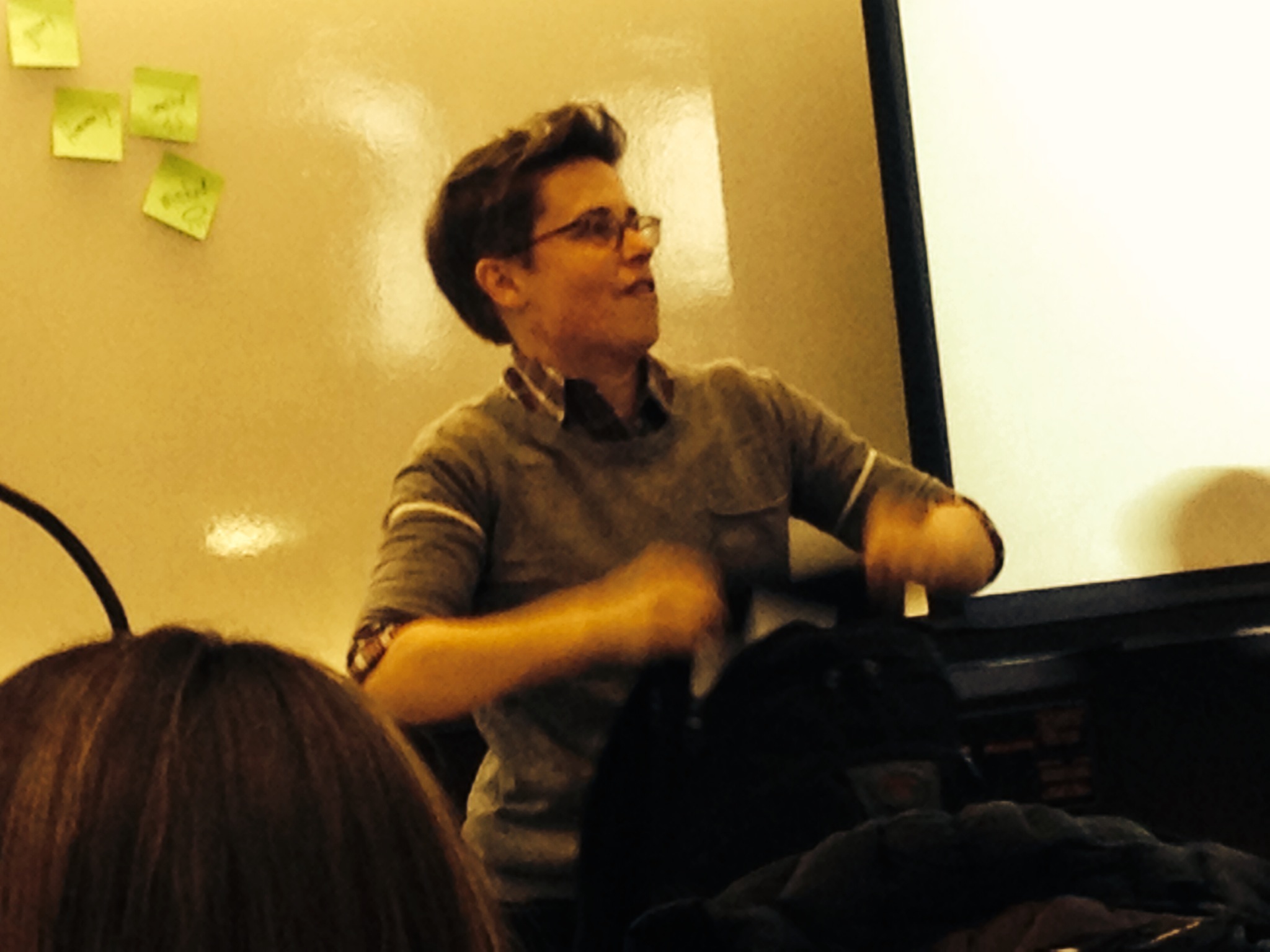
Image 3

Earlier this year I read Falling in Love with Close Reading: Lessons for Analyzing Texts–and Life I had heard so many people talk about and I had read so many things about “close reading” that seemed, well… boring, and non-authentic. But I started to see tweets, and then I read some blogs, including A Day in the Life of a Close Reader. Soon I was reading your book, and well, I fell in love! The passion that surrounds the book and your presentation last Saturday about close reading is contagious.
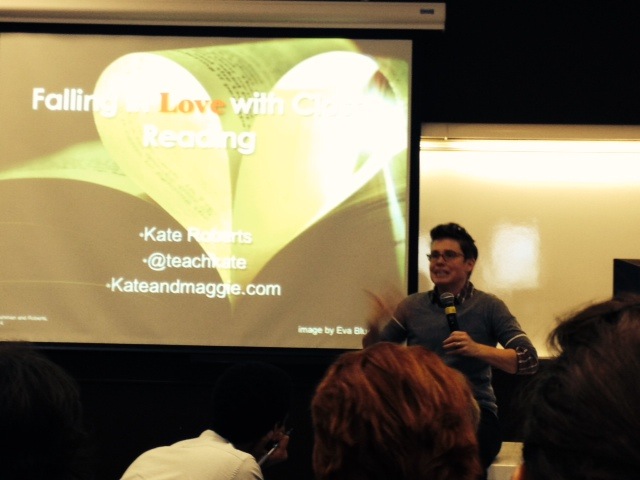
Image 2

You reminded me that…

  • As humans we already know how to come back to something look at the details that we love
  • Students know how to close read because they do it with the things they love in this world
  • We need close reading structure and ritual
  • We should be reaching for happiness,  engagement and independence
  • Close reading is part of a balanced reading instruction

Thank you for taking us through a close read of “Let it Go.” You inspired us with your energy. I loved how you walked around recording what we were saying and used that information to continue the close read. The ritual and structure were there, and it was fluid; the way you showed us how to go from first read, to finding evidence to finding patterns to finding understanding.

Image


All too quickly,  your session was over, and my friend K said: Go! She knew I wanted to meet you.

It’s not my normal personality to jump up and go introduce myself to someone I admire. I had a flashback to years ago (pre-kids) when my husband and I went to a Tori Amos concert at a small venue, right at the time when she was really outgrowing small venues. I remember sitting next to my husband about halfway back as the concert began. When Tori came out on stage, we all got up and I quickly noticed that a lot of people were running towards the stage. I left my husband in the dust, of course, and went closer. I was nervous that I’d get in trouble. If I had more confidence, I could have easily gotten right up to the stage. I stopped pretty close though – and there I stood for the whole concert. We also stood in a small crowd near the stage door and waited for Tori to come out, which she did. She spoke to some fans who were confident enough to push their way into a conversation, and I’ll always regret not pushing my way in to say hello and thank you.

I don’t know if I’m comparing you to Tori Amos here, or not… but I was determined last Saturday to not leave with regret about not pushing my way in to tell you that I so admire your work and your ideas.  So I did. I jumped out of my chair, and pretended it was my normal personality to introduce myself.

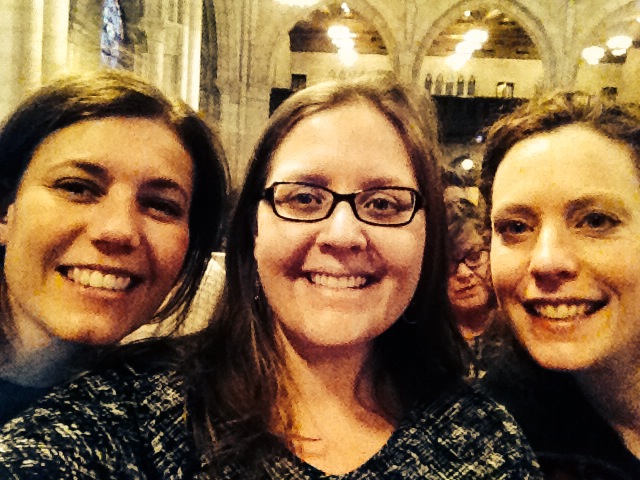
Thank you for acting like it was a totally normal thing for me. Thank you for shaking my hand, asking my name, asking if I was on twitter, and agreeing to a picture. Thanks for letting my friend K sneak around the table to join the picture.
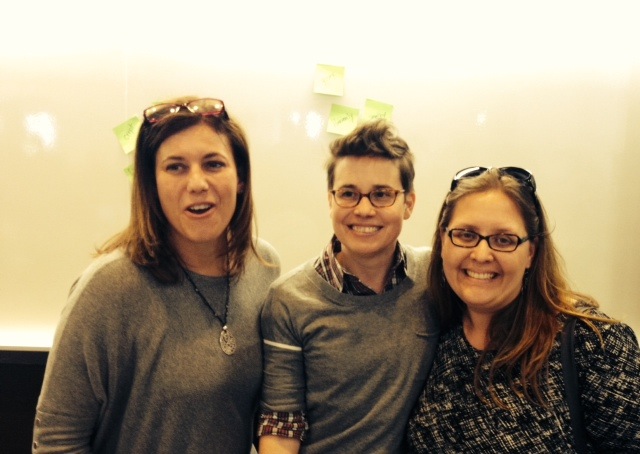
Image 1

When I came back to school this week, I was fired up about close reading. I had been rolling around an idea of having the kids choose songs, videos, etc. to practice the ritual of close reading more independently, so that’s what we’ve been working on this week.

Today students sat happily engaged. They independently close read songs and you tube videos.
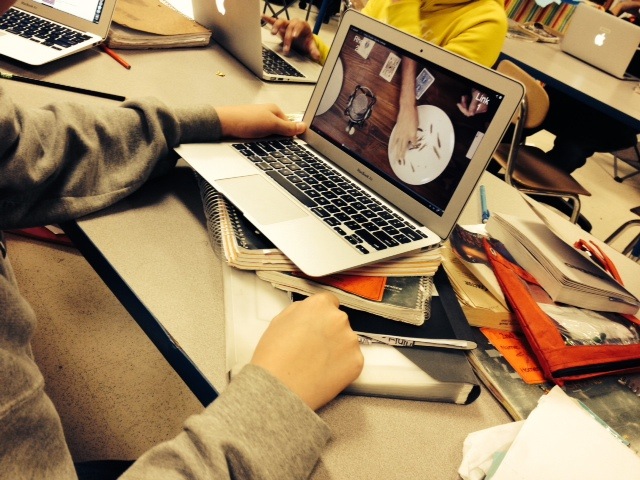
Image Image 1 Image 2 Image 3 Image 4


My intern and I walked around and listened in to their thinking. We discussed and scaffolded. We were impressed… and jealous! We both wanted to do the activity too!

Then, one of my students blurted out: “This if fun! We should do this over and over again!”

Thank you, Kate Roberts!

 

#sol14 March 26 Writing Choices

Slice of LIfe

I am participating in the March Slice of Life Challenge: A slice a day for all of March.  You should do it too! Check it out here. Thank you,  Two Writing Teachers

I’ve been so excited about slicing ever since I found out about it, and started Slicing on Tuesdays. Having my 6th graders Slice instead of my traditional weekly writing assignment seemed more authentic. It was for the most part… for awhile. Some of the slices were awesome, and others were “phoned in.” Students have gotten really great at writing comments to other slicers on our classroom blog. (We use kidblog.)

At first I tried to ignore the complaints (“Do we have a  Slice due again??”) and the groans,  because of how excited I am about slicing. But, then I realized something. I slice because I choose to, my students were slicing because it was an assignment. Duh.

I thought about what I like about blogging. I like that I get to write whatever I want. I like that I get to choose what link ups, challenges, etc. that I want to take part in. I like connecting with readers and other bloggers. So I decided to create choice with my students. I took ideas from blog link ups and challenges I have either done or have read and sound interesting. I made up some of my own as well.  Slices are still an option on Tuesdays. Other options include poetry, book reviews, 25 word stories, opinions and celebrations.  Students will choose one assignment a week to work on.

Today I showed them  the new assignment. One of my students, who has complained before about the slicing, looked visibly relieved when we were done looking at the new assignment choices. “Wow!” he said as he closed his laptop. “This is cool. I can do this.” After the last bell rang and he was at his locker, I talked to him about what he had said and he nodded again. “Yea. It sounds fun.”

“Much better than before.” Another student chimed in.

“I know which one I’m doing first! 25 word stories!” said another.

Students nodded along as they said their goodbyes, and I nodded too. Another review lesson for this teacher: Choice!

I can’t wait to read their blog posts next week.


#sol14 March 25: How do you want to spend your time?

Slice of LIfe

I am participating in the March Slice of Life Challenge: A slice a day for all of March.  You should do it too! Check it out here. Thank you,  Two Writing Teachers

Scene 1: SLO (Student Learning Objectives – Part of the new Teacher Evaluation) Faculty Meeting

My team and I sit and we listen, and we try to understand.

I feel like an idiot, honestly because I don’t truly understand all the rules and percentages, and most of all, I don’t understand the why. SLO, Value Added….  I don’t know much, but know this is busy work for teachers:  Select students, create objectives, fill out paperwork, assess students before and after… Our ability to show student growth will be used (how, I’m not sure) as part of the complicated matrix of our evaluation. Obviously, I already assess my students to inform my teaching.  By all accounts, this won’t be difficult. The teachers who piloted it said we just follow a step by step process.

I blurt out to my team, “I don’t care if this will be easy. It’s stupid.” This is not my most eloquent reflection, but other teachers are annoyed as well and they echo my thoughts: “I don’t have time for one more thing.” “How does the state have the resources to read through our paperwork? They don’t.”  I want to spend my time teaching my students, planning for my students (not to mention some time with my family).

Do I want my students to grow as the year progresses? Of course I do. Do I want to assess my students? Of course I do. I don’t want to do busy work. I don’t want to calculate percentages of instructional responsibility with my math co-teacher. My team wonders a lot. We wonder for instance how our amazing Learning Support teacher (my math co-teacher)  will survive this current “Value Added Measurement” system. One of my colleagues says “She’s not. She will fail forever until they cure learning disabilities.” Her sarcasm makes her point.

My administrator and the others who shared the information with us truly did their best to explain how this will all work. Now I’d like to hear from the Department of Education about why.

While I wait for that answer, I reflect on Saturday’s learning.

Scene 2: TCRWP Saturday Reunion. . . 

We rush up 4 flights of stairs, M gets to the top first (of course) and yells down “It’s full!” So we rush down to the other session we had circled on our program, “Using Media to Strengthen Students’ Critical and Close Reading.”   Cornelius Minor (@MisterMinor) engages immediately, and his content resonates with us. We are immediately grateful for the closed session that made us come downstairs for this.  His fast pace is perfect: He moves around the room and inspires by listening to us and showing us amazing new ideas. This is my kind of professional development – completely full of concepts, rituals and lessons that I can take back to the classroom, reminders of things I know and forget mixed with new ideas that I can’t wait to try with my students. “Play!” he tells us.  “You don’t own vocabulary by writing it down. You have to play around with saying it.” I immediately tweet that.  He reminds us of the importance of skill isolation. All too often we forget this and wonder why students are forgetting things they usually know as they are trying out new skills. Practice skills with media, and then you can replace the media with written text. He tells us that engagement means that kids are ready to fail and get back up to try again, that critical thinking is a ritual

I learned so much, and I brought it back to my classroom for my kids immediately. 

I don’t even need to wonder about which kind of experiences I want to spend my time with: SLOs or planning for engaging my students in close reading and critical thinking. One helps children, one pretends to help the state. When I have the chance to decide how to best spend my time,  I will choose helping children. Every time.


#sol14 March 23 Speak Up

Slice of LIfe

I am participating in the March Slice of Life Challenge: A slice a day for all of March.  You should do it too! Check it out here. Thank you,  Two Writing Teachers

A Slice on the Keynote Address by Diane Ravitch at #TCRWP Saturday Reunion:

My alarm woke me at 6:50 on Saturday morning. My eyes popped open as I reached up to pull on the bedside light chain. Angry sleepy friends, M and K made fun of me for this for the rest of the weekend, but we had places to go! We were ready quickly and headed, map in hand on a walk to Riverside Church.  We stopped for some Starbucks, and to take a quick picture of the “real” Seinfeld restaurant… (We weren’t sure, but I looked it up…) Image 5We arrived with half an hour to spare.

photo 1

M and K knew how much I was looking forward to hearing Diane Ravitch at the keynote, so we hurried in, passing a woman with a clipboard and a name tag that said “Diane Ravitch: Guest.” I felt a slight tug in my brain to just sit down next to that woman so I could introduce myself when Diane Ravitch came, and tell her how much I respect how she is speaking up and defending public eduction. But, that isn’t really my personality, so we went in and found great seats, front and center.

Ready!
Ready!

Lucy Caulkins came out to speak to us before the start of the keynote. I had never “seen Lucy” before. (That’s how people seem to refer to this, as in “Have you seen Lucy? Are you going to see Lucy?”) and I was struck by how comfortable she seemed talking to this huge crowd. She was such a teacher, using her hands to tell us directions and some rules. (“Don’t get hit by a car!”) She then went on to say that she was involved in working on a new website to collect transparent data about common core testing: testtalk.org, she believes it will be called.  She wants us all to contribute, with our names attached. She talked about feeling afraid sometimes to speak up, and how Diane Ravitch is an inspiration for telling the truth, speaking out and taking action.

And yes, when 9:00 came, Diane Ravitch inspired just that. photo 3

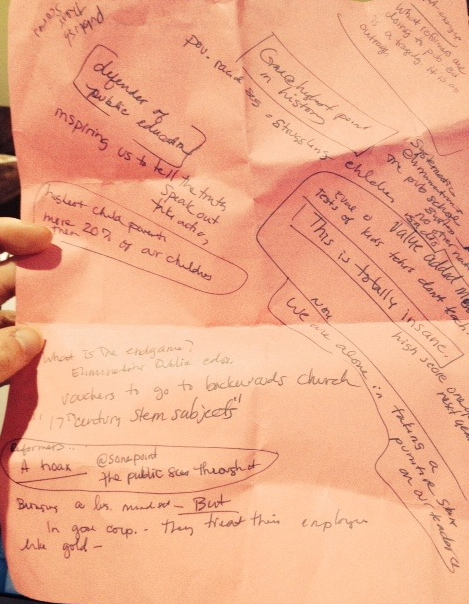
I couldn’t take notes fast enough.

Image 3 Image 4

She painted a sobering picture of what is happening to schools right now, and her facts called me to speak up too. She didn’t hem and haw or measure her words to make them more comfortable and less than the truth. Children are different, she told us, even if taught exactly the same standardized curriculum. “It’s called humanity….Teaching can not be standardized. Children are not appliances…..” She called the situation right now a hoax, and totally insane.

I decided something listening to her. I decided that I do need to speak up. I decided this even though I have it good. I teach in a district that is measured in its approach to the common core, and thoughtful.  But, I need to speak up because the way the common core was developed was not ethical, and in many places, it isn’t being approached in a measured or thoughtful manner. I haven’t been told to teach to the test. But, I need to speak up because there are too many teachers who must do just that. My district puts in a splendid effort to put kids first, and empower teachers. But I need to speak up because there are so many kids who aren’t put first in this country, and so many teachers who have been vilified.  I have worked on unpacking some of the Common Core with my curriculum office, and found many parts to be solid and good practice. But, I need to speak up because there are plenty of developmentally inappropriate parts as well, and children are being pushed too hard. Sometimes, it’s okay to stand on principle and speak up.  Thank you, Diane Ravitch for reigniting me. I will speak up. (Shh…. I did have a whole different  last paragraph that I erased… I was speaking up just a little too loudly…. balance, Ona, balance.) 

#sol14 March 19: Classroom Signs

Slice of LIfe

I am participating in the March Slice of Life Challenge: A slice a day for all of March.  You should do it too! Check it out here. Thank you,  Two Writing Teachers

I am staring at a sign in my classroom: “Sorry about the mess, but we are learning here.” It rings true in my classroom for sure.  Peek into my room,  and you will see an elementary eruption. When we are creating our muppets,  fleece scraps are slumped on desk tops, chair tops, and our own tops. Sometimes liquid watercolor is drying on paintings, waiting to be cleaned up on the counter and still in use by some kids. Supply baskets are full and ready to go. (Truth be told, we often lose track of time, so cleaning up is left until later.)

My mess sign is deeper than that though. The mind is messy: jumbled up while the light bulb starts to flicker, before we’ve been able to file our knowledge in the appropriate mind folder. I imagine it looks like my desk in the summer, when I have all my paperwork out in order to organize, de-clutter, and get ready for the next school year. Who am I kidding? That’s what my desk looks like right now. Yikes!

I should probably edit my sign to say: “Sorry about the mess and the noise, but we are learning here.”  In my classroom we value and practice the art of a silent reading, writing and work time. But we aren’t always quiet (just ask my teacher neighbors…). Our learning squawks and giggles, hoots and stomps it’s feet.  We collaborate, debate, articulate and create our own understanding.  I am proud of my students. They take responsibility for gathering information when they need it. They ask questions, and question answers. I facilitate. I guide, scaffold, correct, help, ask and answer along with them. I am proud of our learning environment – walls of student work and helpful charts. We spend almost all day together in this classroom, it may as well be fun and comfortable.

“Sorry about the mess, the noise, and the colorful clutter. . . but we are learning here.”   

But not today, not the rest of this week. This week I need a new sign: “Today we aren’t learning.” These mornings will be silent. All the colorful charts and helpful strategies have been covered. Students are not permitted to ask me for help. I am not empowered to guide them. (I know, I know, I’m still allowed to help by encouragement.)

They are taking their standardized tests you see – and these tests have very little to do with learning.

I know what you want me to say, reader. You want me to say that of course we need some kind of standardized assessment. But I won’t. Because I don’t think we do. It isn’t information that helps me enough to warrant the stress, the time, or the cost. So I’ll keep giving the test this year, and forever more. I’ll follow the rules and regulations. I’ll cover my posters, count and sign for my tests, silence my class, read the directions and monitor my students. I’ll collect the tests, return the tests, sign that I returned the tests. And tomorrow I’ll start again. But I won’t say we need to do this. Because I don’t think we do.

#sol14 March 15: Using Your Resources

Slice of LIfe

I am participating in the March Slice of Life Challenge: A slice a day for all of March.  You should do it too! Check it out here. Thank you,  Two Writing Teachers

State tests are coming next week. Last week we went over testing tips – general things like “pace yourself” and “It’s just one test.” We were creating a foldable that I made from an idea I saw here. In general, I am not a big proponent of  devoting tons of time to”test prep.” I think my job is to teach 6th grade students to be the best readers and writers and mathematicians and historians (and until this year, scientists too). I believe that all we do in school (especially choice reading!) will help them in life, and as a side benefit, it will help them on standardized tests. We spend time looking at test prep questions almost as a genre study, so that they won’t come as a surprise during the tests.

But this is the kind of test prep I can appreciate – It says to the kids: you’ve got this, you know this, chill out and do your best. I owe it to my students to remind them that they are not only more than a test but can also be successful on the test.

One of my students asked me if they could keep the foldable with them during the test. I had to tell him “No.”

“Why?”

That’s the big question, isn’t it? I explained to my class that the test was standardized, that everyone’s testing experience across the state needed to be controlled, and that the state had decided that no other reference materials were allowed.

But I cringed inside as I said it.

When else in life are we allowed no references, no resources? My colleagues and I wondered about this in the hallway after school…I am still wondering.

So I will cover my word wall, my anchor charts, my posters.  I will put up privacy walls between my students, and I will follow the testing code that I promised to follow.  Then when this year’s tests are finished, I will uncover my walls.  We will be a community of learners again, and I think we’ll use extra resources that next week. . . just because we can. Off to write a lesson where students collaborate in groups, and need a dictionary, thesaurus, online encyclopedia, almanac, and the teacher’s help…. 

#sol14 March 13 The book box (aka How I spend my paycheck)

Slice of LIfe

I am participating in the March Slice of Life Challenge: A slice a day for all of March.  You should do it too! Check it out here. Thank you,  Two Writing Teachers

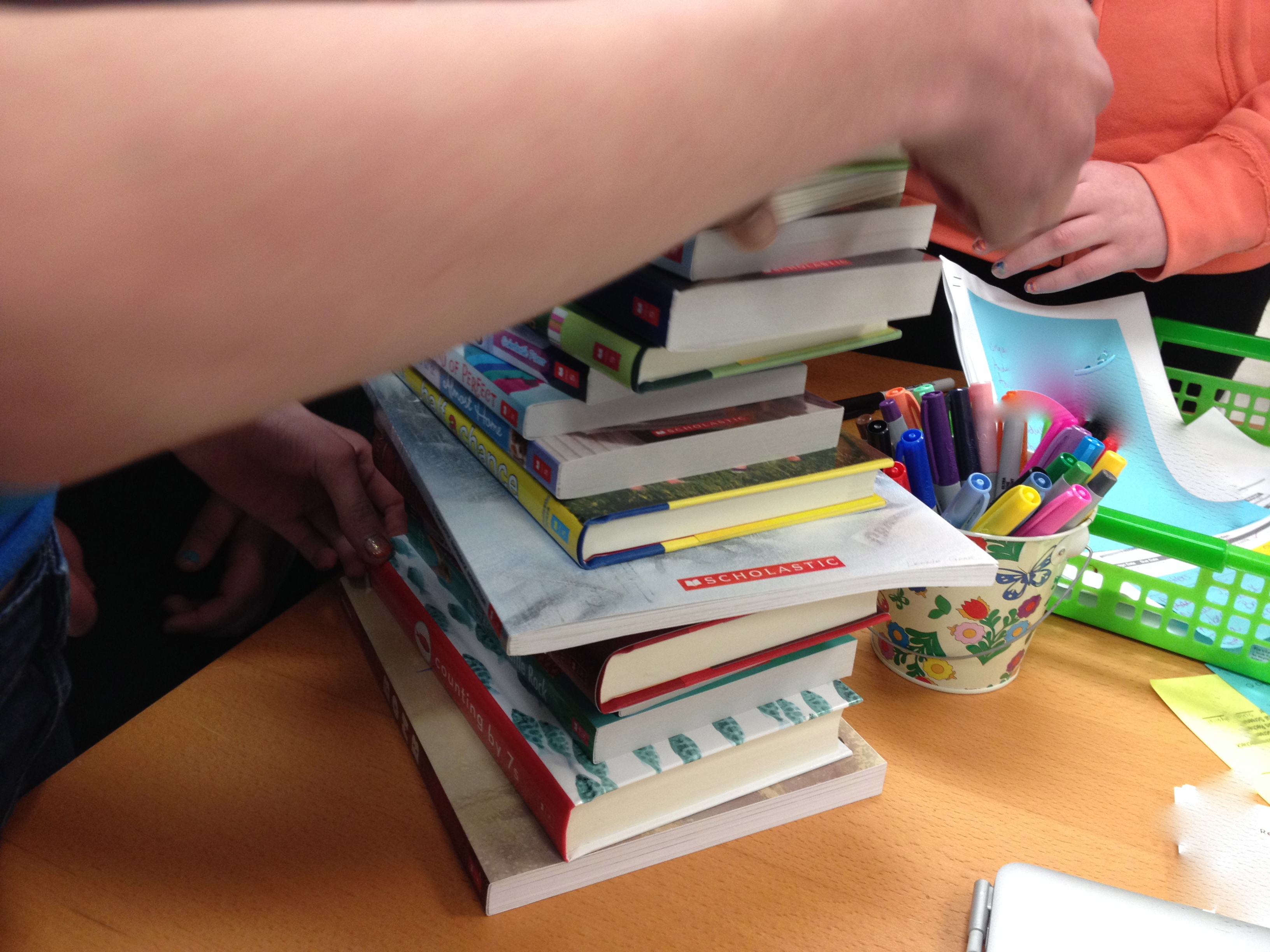
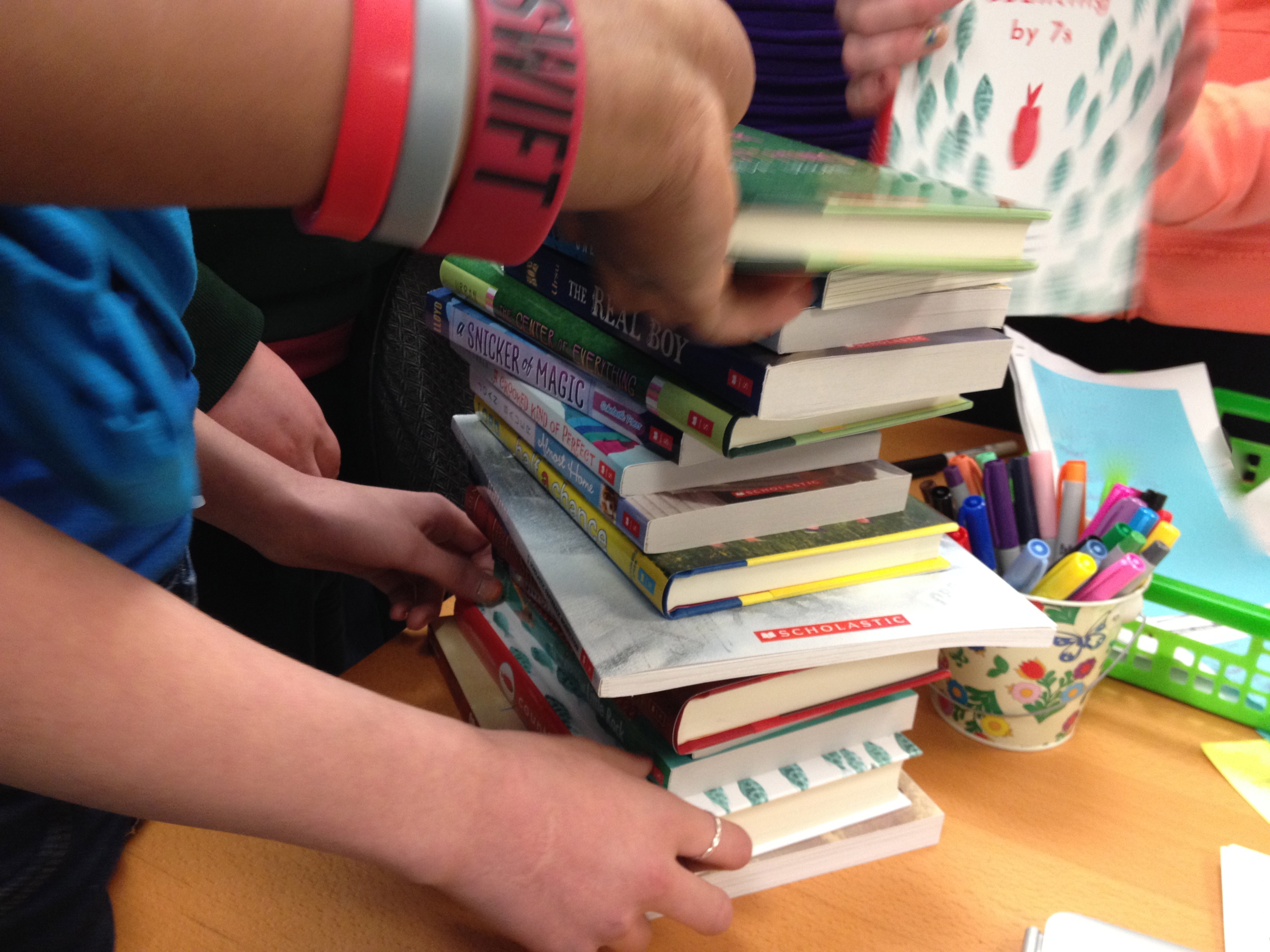
The scholastic box came today. We have been waiting and waiting. . . forever it seems, with spring break in the mix. What is it about a box of new books? My favorite thing is to unpack the books with the kids, and savor the excitement. Today I had to unpack the box without them, so I left the stack on my table and realized a stack of books might be even better than a box. I enjoyed the questioning eyes, the pointing, the asking, “Are these books for us?”

I get it. All I want to do is go home and read these too!

Each time students asked me about the books, I pretended to think about it for a moment, but couldn’t let them worry about it for long. Yes! Yes the books are for you.

One lucky girl caught me before lunch, and asked for a copy of  Counting by 7s, but the rest of the students have to wait until tomorrow when we will look at all the new titles together and settle on our lists of who gets the books. Tomorrow we will also choose our next read aloud. It will be a day of reading choices: My favorite kind of day.

But today was good too: A day for browsing and grabbing and previewing. Students came up at the end of the day to take a look at what their next book might be, ask to be first on the list, and recommend books from the pile to others.

IMG_1122 IMG_1121 IMG_1120 IMG_1119

I find it hard to describe, this feeling of joy while I listen to my students’ excitement over new books. My smile is hard to contain, and I love to listen in.

As I was reflecting on this time we spend in our classroom enjoying reading, I wondered if people might consider it wasted time. After all, “choosing books” is probably not a question on the state tests. (Although, I wouldn’t know since I’m not allowed to see the tests…)  Yesterday I got a parent email that I think answers that question. The parent wrote “… she has finally and surprisingly become a lover of reading — thanks to your own love of reading and your great book suggestions. I want to thank you for the personal attentions that have helped her gain confidence. I am sure that she will be reflecting on your gentle and powerful influence for many years to come.”

I think she is most likely exaggerating my influence – her daughter is a reader and became one for many reasons.  But, I like to think that the time we spend loving books, reading books, talking about books… and enjoying stories makes a difference to these kids.

#sol14 March 12 I remember this

Slice of LIfe

I am participating in the March Slice of Life Challenge: A slice a day for all of March.  You should do it too! Check it out here. Thank you,  Two Writing Teachers

I remember this, when school is quiet in the early morning. I’m the only one in the parking lot, in the hallway. Before I was a mom, I started most days arriving at school before 7:00. Often walking in the dark morning to the door. I’d sit at my desk with my coffee and finish waking up in my classroom, as I put the finishing touches on the days plans. Mornings were the time when I would make last minute copies, anchor charts, straighten up my classroom, and grade papers I hadn’t gotten to the night before.

Now I have 3 children, so my mornings are spent at home getting everyone ready – and there’s rarely a time I get to school early. Usually I’m here just in time.

Sure, today it was still not dawn when I left home only because we recently changed the clocks and nobody is at school yet because it’s an inservice day. I have no last minute plans to do because the students aren’t here today. But it still feels good. It feels good to sit at my desk, and think about the day ahead, to not only have had time to stop at starbucks, but to sit and drink it.

I’m ready for the day!

#sol14 March 5

Slice of LIfe

I am participating in the March Slice of Life Challenge: A slice a day for all of March.  You should do it too! Check it out here. Thank you,  Two Writing Teachers

I miss my classroom couch.
It was pink and curved like a wide C
My students sank in
to read
to talk
to listen
to watch
to sew
        yes we had sewing circles on that couch

If you haven’t spent your days
in a
       windowless
classroom
you may not understand

I miss my arm chair.
It was old and creaky but soft
and perfect 
for read aloud and mini lessons and deep conversations

If you aren’t
11 or 12
in body or mind 
you may not understand 

I miss my soft rug.
It was huge and it fit a large circle of 25 
sixth graders
and a couple of teachers
greeting each other every morning
and learning together all day

If you haven’t tried to sit quietly and read
and work
or listen 
   and listen 
       and listen 
on a hard chair or floor
you may not understand

that community can be built 

with a couch, a chair and a rug
for workshops
for discussions
for relaxing
             gasp! 
for reading 
for writing
for math
for learning

I miss my couch
                  They made me throw it away
I miss my arm chair
                  They made me throw it away
I miss my rug
                  It disappeared one day
My couch, chair & rug before they were gone.

#sol14 March 4 symbiotic attitudes

Slice of LIfe

I am participating in the March Slice of Life Challenge: A slice a day for all of March.  You should do it too! Check it out here. Thank you,  Two Writing Teachers

“I sat in a stool yesterday!”

“I’ve been in a stool for a week!”

“Did you change the chart? I was in this chair yesterday.”

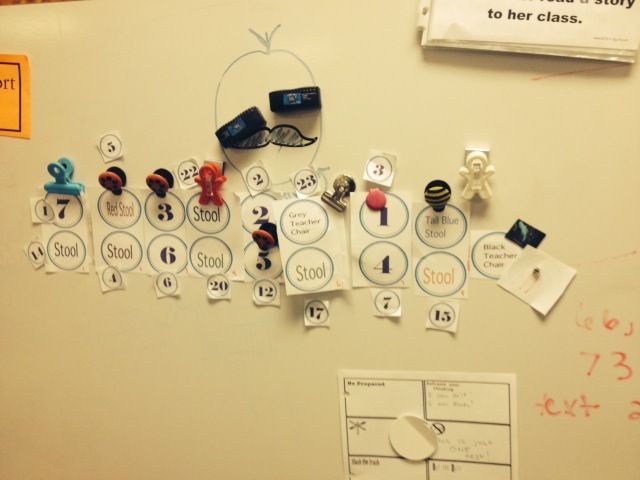
This is how literacy began today. Students were so angry about their seating plan. Their anger made me angry at first. After all, I had finally made the new special seat chart because we all felt that it would be more fair than leaving it up to chance and fate. Up until recently, we had an honor system of sitting somewhere you hadn’t sat recently. That “system” didn’t work, and we all decided that we needed something more formal.

Yesterday I asked them if they wanted me to order the chart differently so they didn’t have a stool for several days in a row as we moved our class numbers through the chart, and they said no. But today, today they were unhappy.

All of these recent events and decisions swirled in my mind, as did the literacy plans I had ready to go… and I started my conversation more sharply than necessary. I was annoyed to take this time.

“Tell me what else I can do?” I said with an edge to my voice. And I repeated all that I had done thus far to help them with the fairness of the chart.

Then a hand went up with a suggestion. A good suggestion. I felt my attitude shift. I took a mindful deep breath – and I listened. I listened and we tried the idea. Then another student added an idea, and we tried that. We cut the chart apart, and moved it around the board.  More students got involved in the conversation, and the magnet moving. The class nodded in agreement with our work. We had a chart to work with that honestly was better than before.

“We’ve lost all the spots people were in before,” I started, “and if I put these magnets up I’m afraid people will be upset that they have a stool again, or the same chair again. The only way to do this is to randomly place them.”

“It’s okay!”

“We won’t say anything. Just put them up and that’s where we’ll sit.”

“We won’t complain!”

It was startling how our attitudes had shifted. Student complaints fed my annoyance – and when a student was willing to engage in the real task at hand,  I was able to break away from my annoyance, and take the edge out of my voice. We found our new chairs, and got down to the business of reading.

The messy work of creating our chair chart!